Find out how to select high-potential startups - the Business Model
April 22, 2020 · von BV4
Catch up on our previous episodes:
Episode 1 - the team - 08.04.2020
Episode 2 - the product - 14.04.2020
Episode 3 - the market - 18.04.2020
In the fourth and final episode of this content series we discuss the key factors that a business model needs in order to start a business and grow sustainably. But it's not just numbers that count; partnerships and pilot customers are also key factors.
The business model might be the dimension that can be adjusted with the least amount of effort during the development of the startup. Yet, it is still recommended to evaluate it thoroughly before investing in a startup. The chosen business model also indicates whether the founders understand their market and clients. One of the most important factors of a successful startup with high potential is the scalability of the business model. Scalability is influenced by a variety of factors such as the development of the marginal costs, the COGS (costs of goods sold) of a product, the possibility to expand the business geographically or the selection of distribution channels. As discussed in the beginning of the article, the evaluation of the startup’s upside potential is key to identify big winners. Hence, a scalable business model is necessary to reach the potential. There are for example various revenue models to achieve scalability such as licensing, franchising, or through monthly subscriptions or pay-per-use. For instance, Blacksocks managed to increase their growth through offering monthly subscription of their socks, which has enabled the company to gain recurring revenues.
Another important success factor is the sales cycle of a company which can be best translated as the time a company needs to sell its product/service. It is very important because it indicates the required effort to acquire new customers. Often, the sales cycles are underestimated when starting a business as the experience with first customers is mostly positive since these are the early adopters that are more easily convinced than the majority. However, it will afterwards become more difficult to onboard the other potential clients resulting in longer sales cycles and higher customer acquisition costs. Another key factor for an upcoming business is the stickiness factor which influences the retention rate. To evaluate that, the costs for a customer to change to a competitor can be estimated and compared. A business that loses its customer base on a constant basis will find it difficult to grow since it must constantly acquire new clients. Hence, startups should create a certain lock-in effect that keeps their customers interested in the solution.
To be able to grow fast, a startup requires healthy partnerships and pilot customers that are willing to accept that the solution might not be fully developed or functional yet. Getting listed at a big retailer, for example, is key for a FoodTech startup since the founding team can receive feedback about the product, use the retailer as a reference customer to increase the trust from others and create brand visibility.
Thus, the business model contains the startup’s scalability, revenue model, required effort to acquire customers including sales cycle and customer acquisition costs as well as the retention rate as some of the most important success factors. The relationship with clients, suppliers and other ecosystem partners are also key elements for an attractive business model.
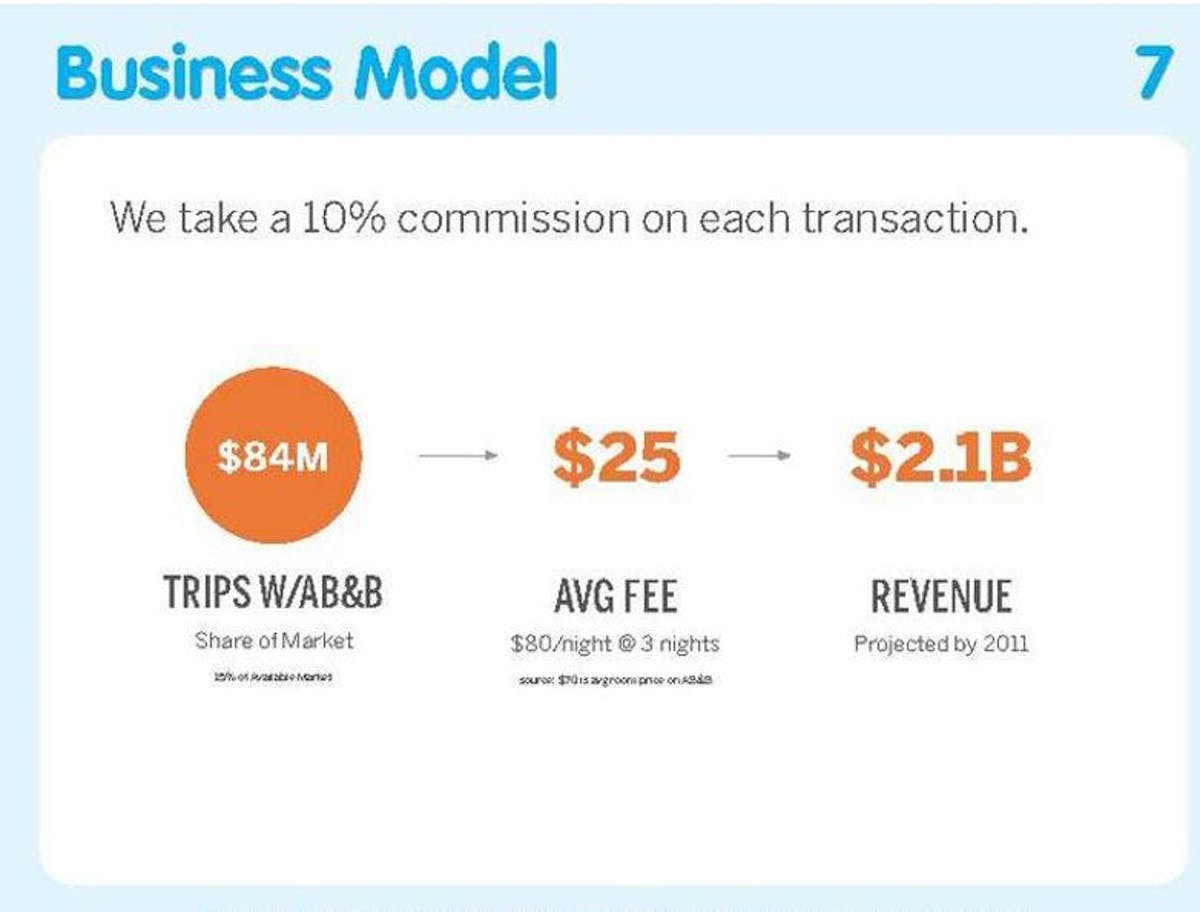
In its pitchdeck, AirBnB’s business model is easy to understand and highly scalable since every transaction creates revenues and the COGS are very low. Further, the customer acquisition costs were reduced by incentivizing the existing customers to invite friends and receive discounts in return. However, as mentioned, also AirBnB was struggling at the beginning to create enough demand. Hence, they have probably underestimated the customer acquisition efforts required on the demand side.
Please find the extract of the old pitchdeck from AirBnB (Seed round, 2009).
Scoreboard
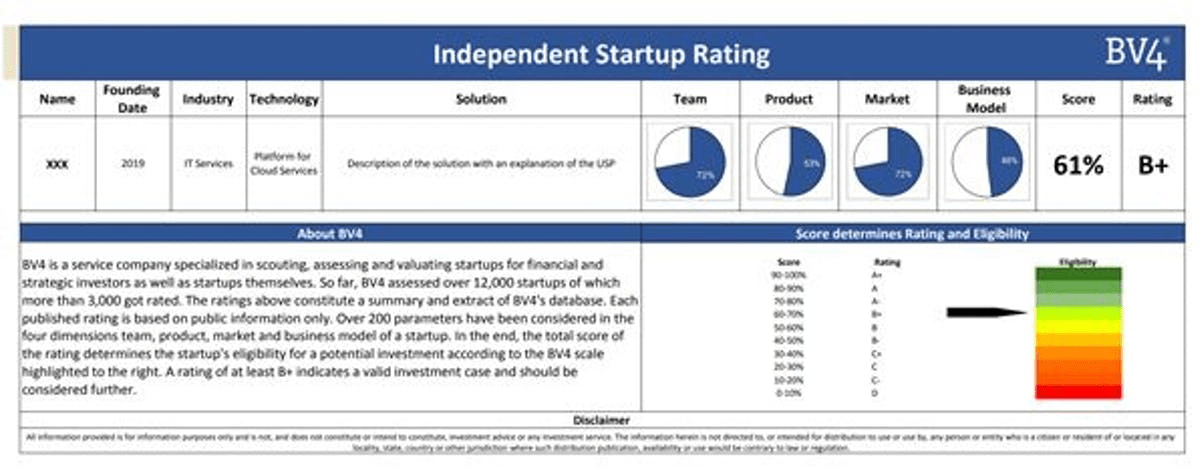
To weigh the criteria and conclude an objective decision whether to investigate further in a startup case or not, a certain methodology is required. A universal scoreboard can help to compare the different cases and choose the most promising ones. Hereby, all dimensions (product, team, market and business model) must be considered and weighted depending on the stage of the startup as well as the strategic intend of the investor. For example, for early stage startups the team is much more important than the business model since the latter can still be adapted. Yet, for a strategic investor, the product and its technology might be much more important to create a technology spillover. Generally, an investor should therefore exactly know what the investment strategy is. The following graphic shows an example of such a scoreboard.