
Find out how to select high-potential startups - the Team
April 8, 2020 · von BV4
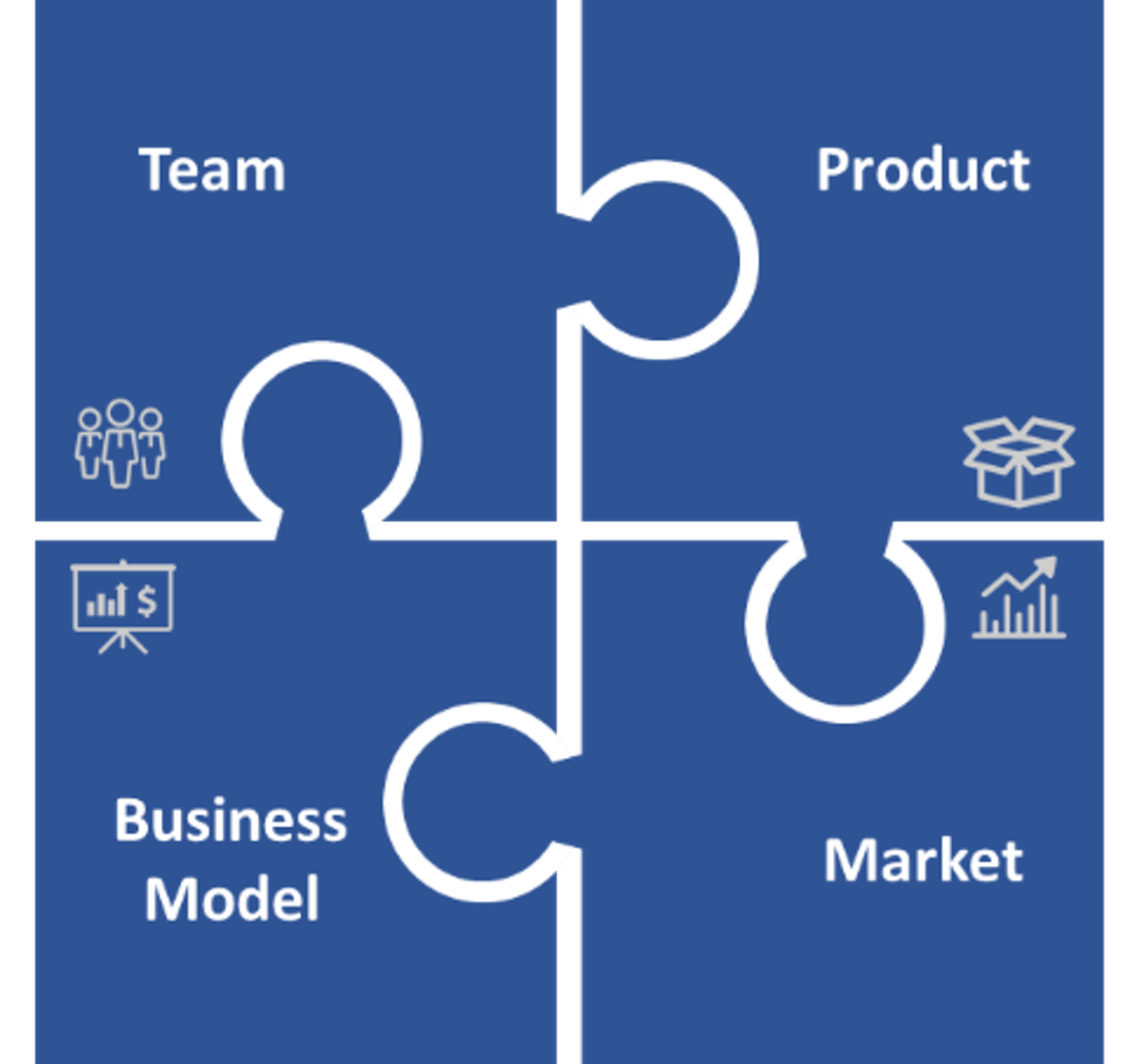
Venture investment, the private equity financing in a startup, offers average IRRs (internal rate of returns) of more than 10%. Yet, the increased possibility of a great investment come with a high price in the form of substantial failure risks. In fact, approximately 90% of all startups fail. Consequently, it is crucial to identify the high-flying startups since they are the ones that make your startup portfolio successful. Yet, what characterizes a promising startup? The following article will give an overview of the most important factors to identify a high-potential startup. For that, four dimensions that are relevant for all businesses alike have been defined. These are the team, the product, the market it operates in and the business model it operates with. This is a small content series split in four parts. Let’s start with the team.
1. Team
When analyzing the founding team both the hard and soft factors have an impact on the likelihood of success of a startup. Obviously, the background of each team member should be considered. Do the founders possess the relevant background for their functional roles? Does the founding team have skills in team and project leadership? Do they have relevant experience in the startup field, such as being part or having founded a startup previously? A crucial success factor can also be the complementarity of the team members skill set. For example, many high-tech or deep tech startups have failed because they were purely owned by engineers who loved their product, tried perfecting it, but failed to bring it to the market adequately. Finally, being able to rely on a strong advisory board with different skill sets and a great network to boost sales and partnerships is also a strong asset for a team.
In the age of data analytics, there are plenty of statistics about the perfect cast for a startup team. The presence of a female team member or a founding team with an average age of over 30 is statistically more promising for instance. Yet, in the end, there are examples of all kinds of composition of founders that succeeded or failed. Hence, the soft factors are at least as important when evaluating the capabilities of a team.
For the evaluation of the soft skills, it is inevitable to have direct contact with the founding team. One should assess how they collaborate within the team, how they are structured, how they work on tasks, and what drives them. A study of HBR found out that besides the hard factors, the most important traits for founding teams are shared entrepreneurial passion and shared strategic vision. Whereas the passion must be felt while interacting with the founders individually, the shared vision should be questioned individually from all founders.
Another factor that differentiates strong teams from weaker ones it their resilience. Working in a startup means that you are constantly faced with new challenges. Those who can overcome these obstacles them give themselves the chance of being successful. In fact, some of the fastest-growing startups were founded during the financial crisis, namely Uber (2009) or AirBnB (2008) which was nearly bankrupt one year after being founded. Yet, the founders showed resilience and moved on. A similar case is the new unicorn, originally from Switzerland, GetYourGuide (2008), which was also founded during that time. Resilience can, for example, be evaluated by looking at the previous challenges the team already had to overcome.
To conclude, the evaluation of startup teams does not only include hard skills like previous industry, leadership and startup experience, a strong advisory board or complementarity of skill sets within the founding team but also soft skills such as shared passion and strategic vision as well as resilience to be successful.
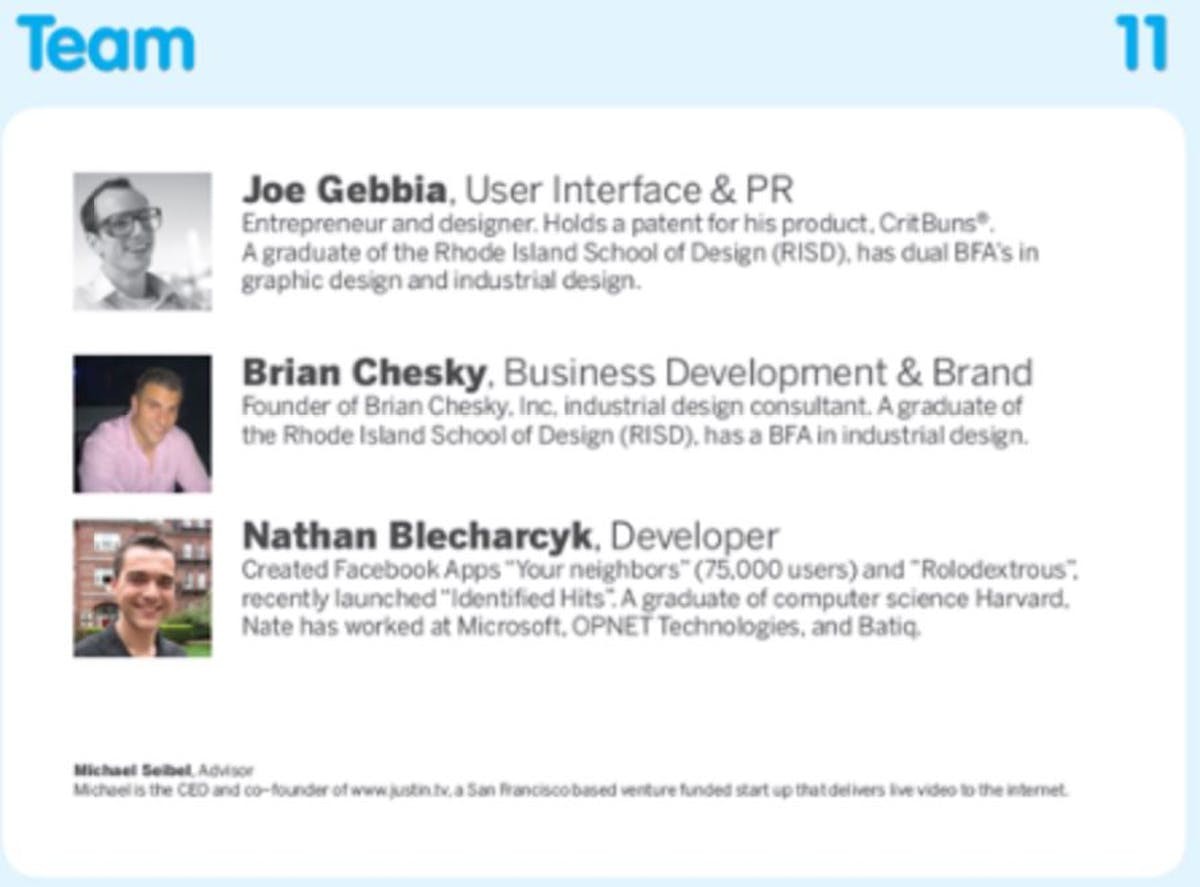
Let’s look at AirBnB more closely and analyze the company based on its first pitchdeck when it was looking for its first seed investment. The three team members had complementary skills ranging from business, design, branding to coding knowledge. Further, some team members had already gained some experience in the startup industry and founded their own app startup with a track record of 75’000 users for example. Yet, there was no indication of any advisory board. This example shows how difficult it is to define the strength of a team without interacting with them. Hence, a meeting or call is always recommended, especially for such an early-stage company where the team has a big influence on its success.
Please find the extract of the old pitchdeck from AirBnB (Seed round, 2009).
Scoreboard
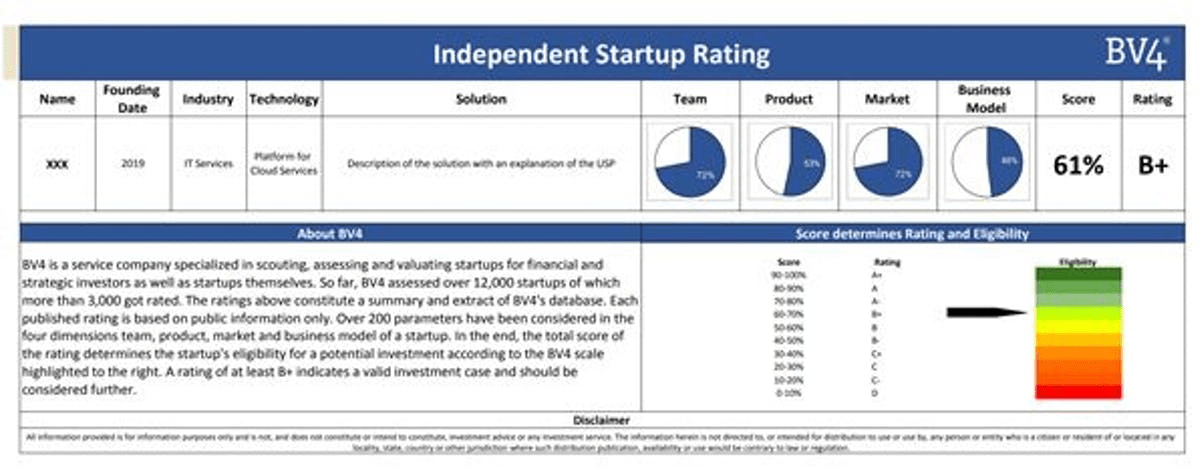
To weigh the criteria and conclude an objective decision whether to investigate further in a startup case or not, a certain methodology is required. A universal scoreboard can help to compare the different cases and choose the most promising ones. Hereby, all dimensions (product, team, market and business model) must be considered and weighted depending on the stage of the startup as well as the strategic intend of the investor. For example, for early stage startups the team is much more important than the business model since the latter can still be adapted. Yet, for a strategic investor, the product and its technology might be much more important to create a technology spillover. Generally, an investor should therefore exactly know what the investment strategy is. The following graphic shows an example of such a scoreboard.
To episode 2 - 14.04.2020
To episode 3 - 18.04.2020
To episode 4 - 22.04.2020