
Find out how to select high-potential startups - the Market
April 18, 2020 · von BV4
Catch up on our previous episodes:
Episode 1 - the team - 08.04.2020
Episode 2 - the product - 14.04.2020
3. Market
Welcome to episode 3 of how to select high-potential startups. This article gives you an overview of what a market valuation should include and what you need to consider before starting your own business.
There is probably no market that does not have the potential to be disrupted one day. For example, Yamo, a Swiss startup that develops fresh and organic baby food with a unique production process and product presentation managed to disrupt the Swiss market. It addresses customers in a mature market that has not faced change in the last 60 years and competes against giant players such as Unilever and Nestle. Consequently, the evaluation of the market requires more than an analysis of the market's maturity. The market size should be considered as well. In some markets, a market share of a few percentages can already bring a huge cash inflow whereas some startups must become market leaders to survive. This is especially the case for platform cases that function according to the winner-takes-it-all principle since network effects are required. For instance, the market for payment platforms such as Paypal or Twint does not offer much space for a lot of competitors since such a new payment solution can only work if there are enough users and if many point-of-sales offer the possibility to pay with the solution. Another important measure for the market analysis is the market growth. Most markets are moderately growing (4 to 9% CAGR as a rule of thumb) due to economic and population growth but there are some markets that expect an outstanding growth in the upcoming years such as smart city applications, autonomous driving or the cybersecurity industry. A growing market offers potential for market players to grow as well.
An essential part of the market analysis is the evaluation of the competition since this also helps identifying the competitive advantages of the solution of the analyzed startup case. Besides analyzing the level of competition analysts should also be interested in answering the following two questions. How high are the market entry barriers for future market players? How big is the threat of substitutional products that make the innovation obsolete again? The market trends are a crucial element when analyzing the market as well. Here, different dimensions like technology, regulations, economic, ecologic and society should be considered. They can enable a new technology or create a new customer need offering new opportunities for startup businesses. Of course, some trends and regulations can also harm some business models. As mentioned before, AirBnB was about to go bankrupt. The founders underestimated the importance of the quality of the pictures taken from the apartments. Since the mobile phone cameras offered a rather weak quality, most guests decided against booking on the platform and went to traditional hotels instead. Soon after the quality of the pictures had improved, the business of AirBnB started being much more attractive for customers. The example shows that sometimes it just requires some small developments in the ecosystem to alter the market conditions for the market players.
Especially regarding a pure financial investment, one of the key criteria in the market dimension is also the exit potential. Hereby, trading multiples (such as Sales/EBITDA/EBIT multiples) give an indication on whether a startup in a certain industry is attractive for potential buyers or less. Additionally, it is suggested to consider who could be the potential buyers to assess the attractiveness of the startup. For example, a travel platform startup is likely to be bought by some of the key players in this market such as Expedia or Booking Holding if successful since a high level of M&A activity could be identified in recent years in this industry.
To conclude, the market evaluation should include a competitor and market trends analysis as well as information regarding exit potential, market growth, size and potential to receive a holistic view of its attractiveness.
Additionally, to the already discussed influence of technological trends, the AirBnB case seemed to be very promising since it tackled the hospitality market that used to be very traditional without much innovation. With the emergence of services like Couchsurfing and Craigslist, the peer-to-peer industry has grown already, and people were becoming more aware of these new opportunities. AirBnB could also benefit from the growing travel industry.
Take a look at the extract of the old pitchdeck from AirBnB (Seed round, 2009).

Scoreboard
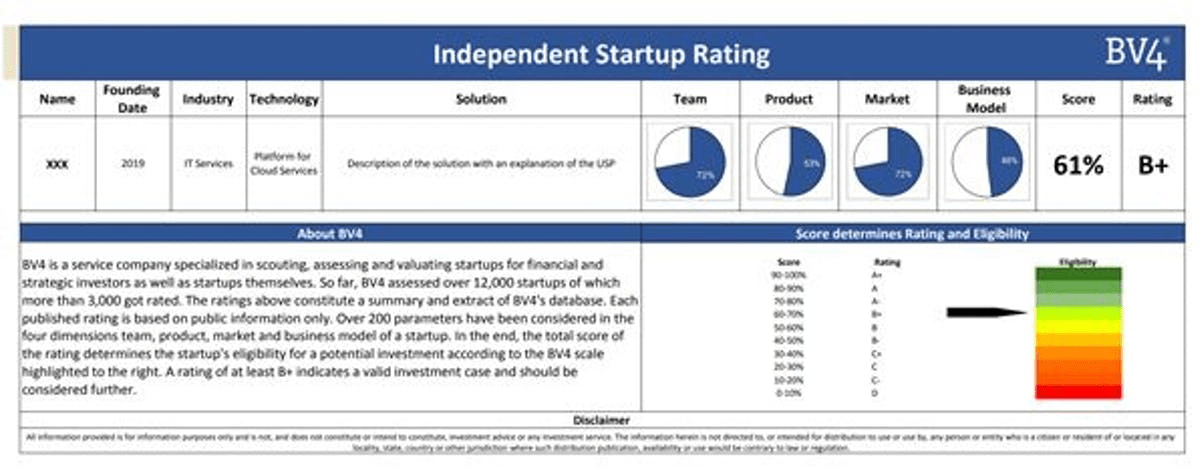
To weigh the criteria and conclude an objective decision whether to investigate further in a startup case or not, a certain methodology is required. A universal scoreboard can help to compare the different cases and choose the most promising ones. Hereby, all dimensions (product, team, market and business model) must be considered and weighted depending on the stage of the startup as well as the strategic intend of the investor. For example, for early stage startups the team is much more important than the business model since the latter can still be adapted. Yet, for a strategic investor, the product and its technology might be much more important to create a technology spillover. Generally, an investor should therefore exactly know what the investment strategy is. The following graphic shows an example of such a scoreboard.
To episode 4 - 22.04.2020