
Find out how to select high-potential startups - the Product
April 14, 2020 · von BV4
Catch up on our previous episode.
2. Product
Welcome to episode 2 of how to select high-potential startups. This article gives you an overview of the most important factors to consider when it comes to a startup's product.
When evaluating the potential and quality of the product, the most important factor is arguably the product/market fit. Even though it sounds obvious that a solution must solve a customer’s need to convince people to pay for it, the missing product/market fit is reason number 1 why startups fail. But just solving a customer need is not enough to convince customers to buy a product/service. In fact, the solution must have a clear and unique value proposition that differentiates itself from its competitors such as a cheaper price (e.g. Flixbus), more convenience (e.g. Zalando) or better quality than others (e.g. BeyondMeat). Otherwise, the marketing and sales team will encounter great difficulties convincing potential buyers to adopt and pay for the solution.
The product itself should also be analyzed thoroughly to define the development stage of the product. It is normal that the solution of a startup is not yet fully developed but it is essential to have an idea of when the solution will be ready to be tested on the market, even if it's just a first alpha or beta version. Coming back to the Unique Selling Point (USP), another success factor of a startup in the product dimension is its ability to maintain its competitive advantage and unique features. Hence, the importance of the level of Intellectual Property (IP). Here, the term IP should be seen in a broader sense meaning that there are more ways to secure its technology than just by patenting it. The classification of David Teece[ is still widely accepted and shows that an invention must fulfil two criteria to capture the profit from it. First, the inventor must have a strong appropriability meaning, that they can protect their IP well from others. Second, the invention must be supported by complementary assets that help scaling up the idea for example through marketing, distribution capabilities and process knowledge. For instance, the algorithms of software solutions cannot be patented but their level of IP can still be very high if the team has worked on the project for years and built everything from scratch and under high confidentiality. If the company is further capable of choosing a smart way of scaling up its business, it can have sustainable success with its invention.
Take a look at the extract of the old pitchdeck from AirBnB (Seed round, 2009).
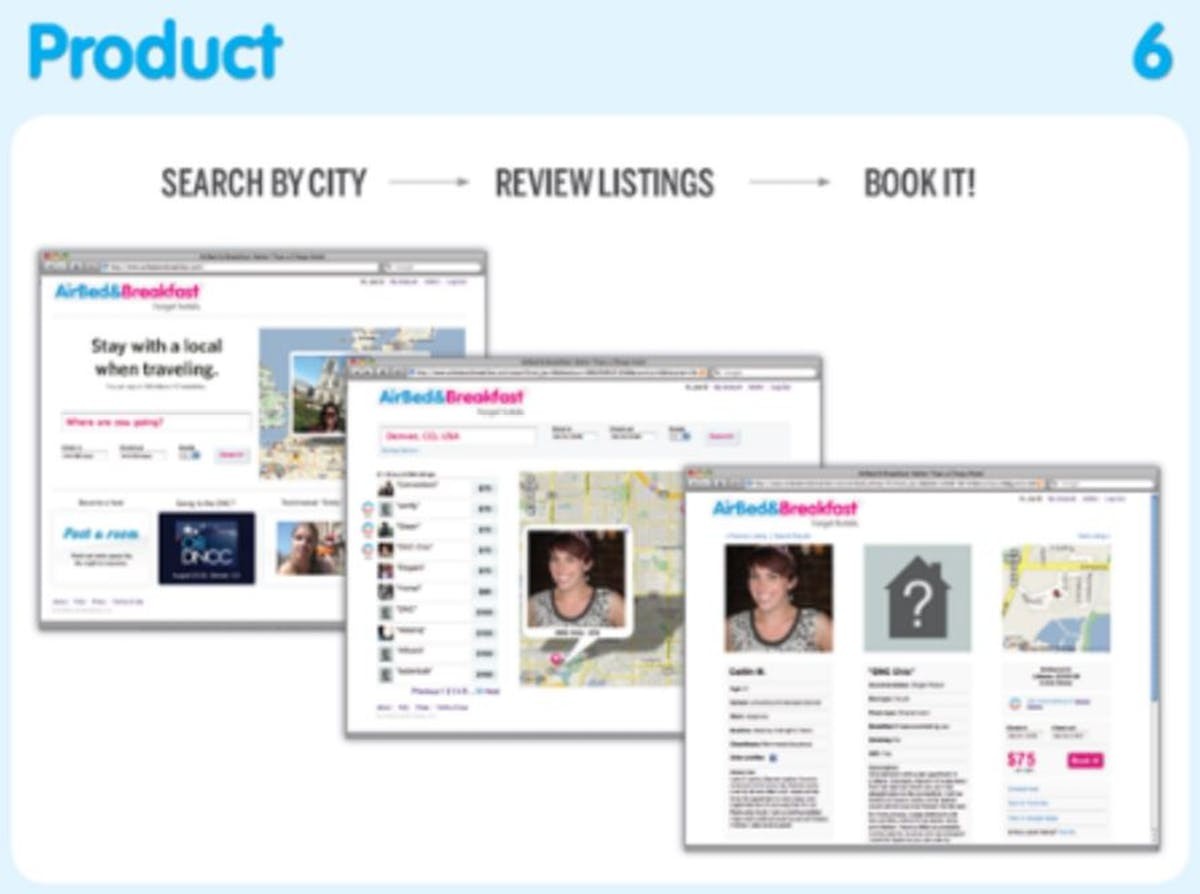
To sum up, some of the key success factors of a product or solution are the product/market fit, its IP, the level of customer need it solves, its differentiation capacity from other products as well as competitive advantage. Additionally, the likelihood of a startup’s success also depends on the development stage of the product.
If we look again at the proposition of AirBnB for its seed round, we see that not much information is included indicating that the product might not be fully developed yet. However, a clear product/market fit can be identified. People that do not use their flats or houses can generate an additional income by sharing their space to others. On the other hand, tourist can find an affordable accommodation very easily on a central platform. The defense mechanisms to protect IP are few, hence, the product must launch quickly to gain traction to subsequently make it difficult for competitors to achieve the same network effects.
Scoreboard
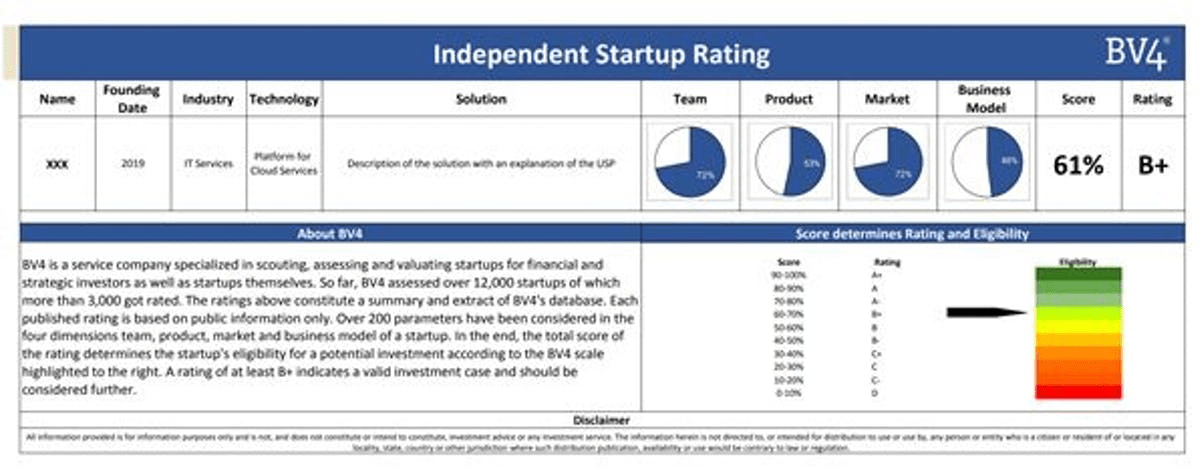
To weigh the criteria and conclude an objective decision whether to investigate further in a startup case or not, a certain methodology is required. A universal scoreboard can help to compare the different cases and choose the most promising ones. Hereby, all dimensions (product, team, market and business model) must be considered and weighted depending on the stage of the startup as well as the strategic intend of the investor. For example, for early stage startups the team is much more important than the business model since the latter can still be adapted. Yet, for a strategic investor, the product and its technology might be much more important to create a technology spillover. Generally, an investor should therefore exactly know what the investment strategy is. The following graphic shows an example of such a scoreboard.
To episode 3 - 18.04.2020
To episode 4 - 22.04.2020