
Scouting to identify high potential startups
August 15, 2019 · von Dorian Ebneter
Worldwide, around 1’350’000 tech startups are founded every year*. This number does not even include other founded companies in non-tech fields. How can investors find the needle in this haystack?
Not only are corporations confronted with a high number of newly founded startups but also with limited information about them. Startups often do not have the resources to attract a wide audience. Furthermore, they are globally dispersed and sometimes not even referenced on Google such as many of the Chinese startups which can only be found on Baidu. In addition, companies must act quickly in finding the right startups. No innovation manager wants to read a competitor’s success story related to a startup investment in which they missed the opportunity for their company. In addition, startup scouting requires a lot of resources if done thoroughly, since it requires a constant monitoring of the fast-moving markets.
But why is the scouting of startups such an increasingly important topic**? Generally, the benefits of collaborating with startups can be divided into two dimensions, namely the strategic and financial perspective. Corporate organizations are challenged nowadays by fast-growing and disruptive startups as well as technologies and business models. Since internal innovation is limited by resources, culture and structure, the collaboration with startups is an alternative way of bringing knowledge, talents, technologies and sometimes even a new customer base into a company to secure growth and market share for the future. From a financial point of view, an investment or acquisition of a startup is an attractive opportunity to generate a high return on investment***.
By answering the question why a corporation starts scouting for startups, the company has already started with the first of four steps in the scouting process.
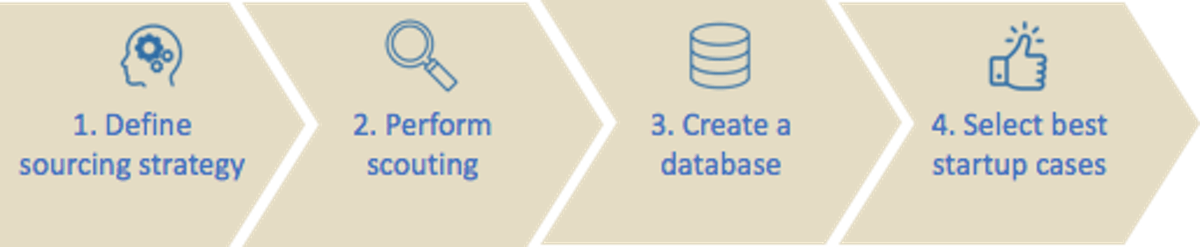
1. Define sourcing strategy
Apart from the definition of the objectives, another key element in the scouting strategy is the definition of the scope. Several characteristics must be defined to narrow the sheer number of startups down to the corporation’s objectives.
- Focus area: First and most importantly, the organizations must define in what kind of innovation fields or technology clusters it wants to scout startups. If the aim of the scouting is more strategic, it is further recommended to define key challenges the startup could solve with its technology or key markets it could tackle.
- Type and stage of startups: The predefined development stage of a startup should be in relation to the defined risk and benefit appetite the company has. For instance, scouting for seed startups allows to create a first-mover advantage and reach out to talents but involves high risk of failure. A collaboration or investment at later stages brings different benefits, such as proven technologies and business models. Yet, the financial upside potential is less attractive for an investment in a more mature startup with a higher valuation****.
- Development stage of the product: If pre-seed or seed startups are targeted, the proof of concept is not always completed yet. Whereas for later stages, the products or services are usually finalized and sometimes difficult to copy due to patents and registered trademarks.
- Geographic coverage: Even though it is recommended to look for innovative startups and technologies on a global scale, simply because innovation does not respect borders, the firm might have some regional preferences that must be considered. Additionally, depending on the strategic intend, geographic proximity eases collaboration and knowledge transfer between the organizations.
2. Perform scouting
When it comes to startup scouting, having dedicated people with a great understanding of what characterizes a promising startup is essential. A high level of experience and the capacity to learn from previous scouting projects is inevitable and increases the quality of the identified startups. The task requires clear ownership and constant monitoring of the market since the window of opportunity to collaborate or invest in a startup is usually very short.
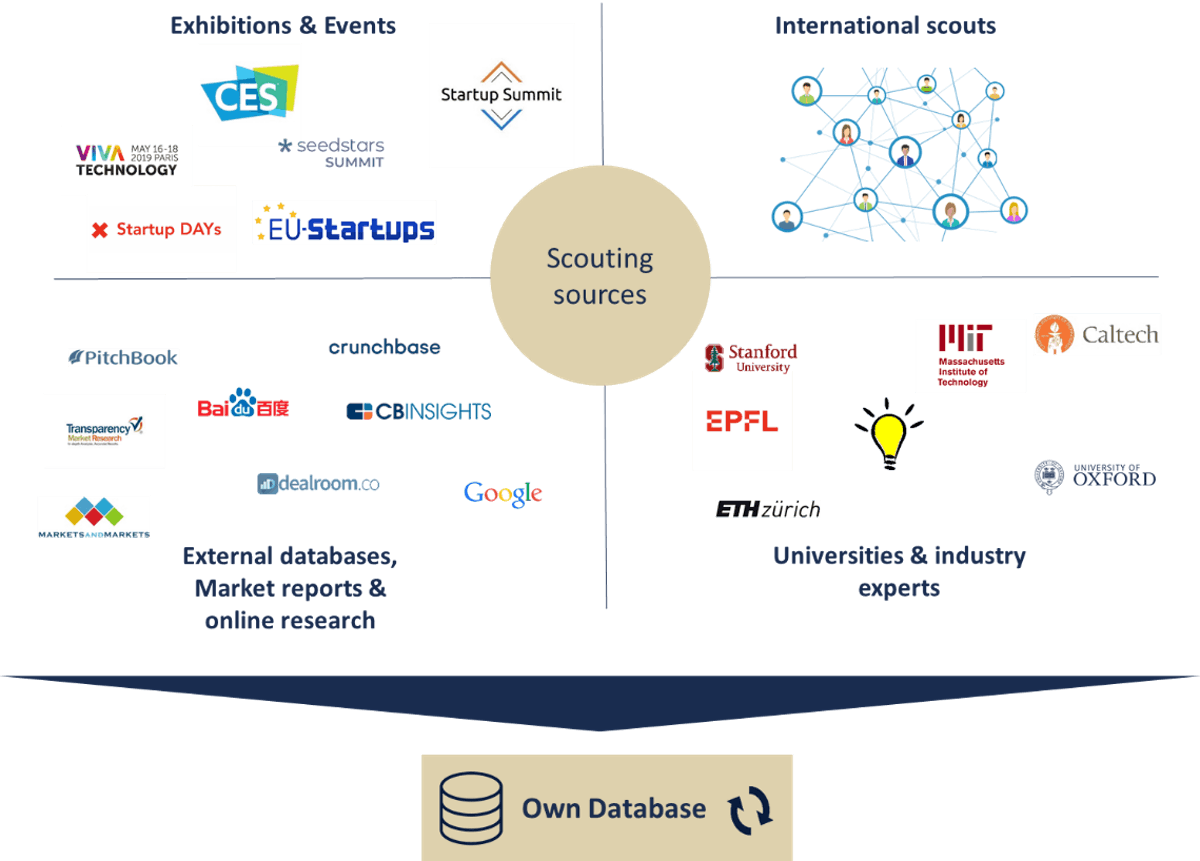
To get an overview of the market, it is recommended to start the scouting process by choosing the right sources available online, which can be specialized startup and tech websites like Techcrunch or Medium, online database referencing a vast list of startups such as Dealroom or Pitchbook and of course search engines.
Offline channels such as events (fairs, conferences, demo days, pitch competitions) are also a great way to get in touch with startups, even though, they present a relatively inefficient source. To increase efficiency while scouting at events make sure to prepare before the actual event and schedule appointments with promising chases beforehand if possible. Since scouting is mostly done globally, the direct contact to specific startup scouts can be of huge benefit, especially in areas where there is limited information regarding the startups due to language barriers or internet restrictions. A close connection to top universities can also be a potential source, especially to scout early projects and new talents.
3. Create a database
Since the scouting process should be ongoing, building a database with all identified startups is key to track and monitor them. A startup with a promising project or vision, but without having reached a certain technology readiness yet could end up disrupting the market a year later. Hence, it is essential to be up to date and ready to act once an investment opportunity is identified. Further, a database is also useful to compare newly identified cases with already known startups. The best performing startups can be selected easier and market trends are recognized earlier. Yet, this requires an extensive and powerful database.
4. Select best startup cases
The product of the scouting process should be an actual list of promising startups that fit the predefined scouting strategy and are worthwhile to contact and assess more closely, also based on the information the founders provide. From experience, startups are becoming more eager to collaborate with big organizations since they are aware of the benefits such a collaboration can contribute to their business. However, since the topic is generally receiving increased attention, they are also alert towards drawbacks that corporate venturing activities have on their business success. Additionally, entrepreneurial firms can choose from an increasing variety of investment and support options. Therefore, make sure to develop a forthcoming process which is positive for both sides of the collaboration.
This blog article presents the start of a series of articles discussing the investment process from scouting, analyzing and valuating startups from a corporate perspective.
** HBR (2019)
*** Pitchbook (2019)
**** see Damodaran (2009), Valuing Young, Start-up and Growth Companies: Estimation Issues and Valuation Challenges (p. 15)
Scouting of BV4 enables us to get the valuable insight about high-potential startups.